Race Recap: Rhythm and Blues 5k

I ran a race last weekend that gave me the opportunity to counteract a mindset that had been holding me back, a mindset that created a belief system that had me giving up too often. I touched on this aspect about myself in a previous post. I had identified an ugly work pattern that exists not only in my racing style, but in my general life approach. The picture: I rush into something and then give up. I might not necessarily leave the venture alone entirely, sometimes I’ll just give less effort. Believing the goal I set is unattainable, maybe because of some minor setback or unforeseen obstacle, I’ll either divert my energy to an easier cause, or lower the bar I was originally reaching for. It’s a self-protecting measure I developed to protect an oversensitive ego. This way of living no longer serves me the way it once did. As I get older, the thought of leaving more undone is colliding with my increasing awareness of mortality and legacy, and how I see myself is mattering more and more than what I think I can prove to others.


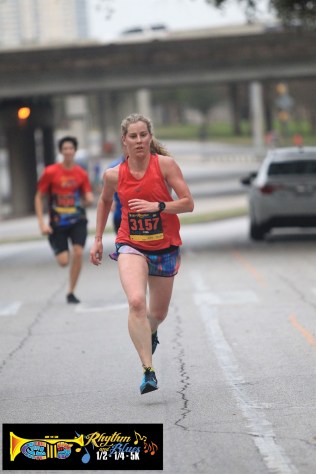
In the 5k I ran last weekend, and I went out too fast to start. I projected from my workouts prior to the race that I could run a 7:45 pace, and hold it for 3 miles. However, my pace for the first mile was a 7:33, likely much faster than that for the first half mile. Going out with too much intensity meant I didn’t have as much left for the second half of the race, which consisted of more uphill running than the first half. I kept my eye on my pace, and watched it steadily climb, to 7:40, 7:50, and past 8:00 once I was on the uphill. Everything hurt. Aside from going out to fast, I had almost no warm-up, as I overslept, and my only pre-race activity was running from my car to the starting line, where the National Anthem was being sung just as I arrived. So, with less than a mile of warm-up to get me going, I moved to the front of the pack anyways. I could have hung further back in the crowd, which would have helped slow me down to start, but that morning I knew I didn’t want to deal with moving around other runners as the race got going.
140475-320-024h
I don’t think I was even at the first mile marker at this point. I’m looking ahead to the top of a hill (or what constitutes a “hill” in Houston)

So that was what was happening on the ground. In my head, mile one felt like it took forever, even though I was running fast. Mile two was even longer. I was actually looking forward to mile 3 even though I was starting to feel like there was lead in my legs, because I knew all I had to do was run to the end. Just keep running. This is where some of my workouts were really helpful. I’ve taken to only jogging or running for rest between working intervals, which has done something great for my mindset- I don’t stop. I hope I never walk in a race shorter than a half again, as I’ve sort of eliminated any excuse for that through practice. I now know that no matter how exhausted I feel, I can pick my feet up and put them back down again at a decent pace until the worst of whatever I’m feeling goes away.


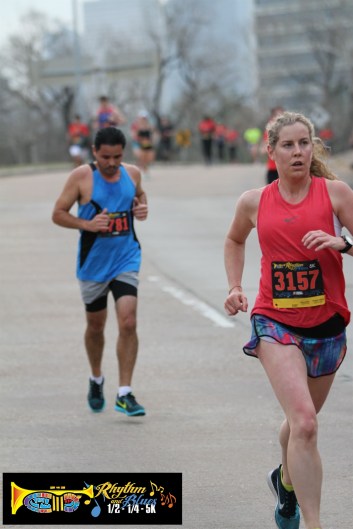
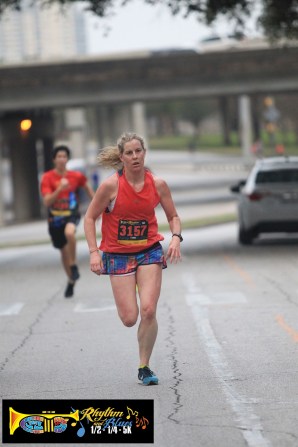
In the last half mile, I didn’t want to walk or slow down, but I did really want to stop giving so much effort. It wasn’t getting me anywhere anyways. I’d push harder, only to look at my watch and realize I was still running an 8:06 pace, which was pretty demoralizing. (I may run the next race without the watch and see what happens, on that note). The thing is, I didn’t let up, I still pushed, and at the end of the race, when I heard footsteps behind me, I somehow found a kick. I had been using other runners as benchmarks to keep me moving forward as strongly as I could, and I didn’t want to give up a place in the last 100 meters. The runner didn’t catch me, I’m happy to report, and the photog captured some great images of it all.


I finished in 24:31, cumulative pace of 7:53 per mile. I was third for my age group (30-34), and 9th female overall. I was not thrilled about this result, even though I recognize it is far from something to complain about. The more time I’ve had to analyze, the more I see that it was a really good race to start to look at what I can improve on. First and most obvious- prep better. Wake up on time, eat breakfast, do a decent warm-up. That one’s easy. Second, I need to work on my form some, I’m looking at pictures and noticing that my left arm has a tendency to cross my body too much, thought its possible that I could have just been looking at my watch just before the snap. Third- stop relying so much on the watch. Learning to gauge pace from feeling would really serve me, especially for goal four- hold back at the start. And finally, fifth thing to work on is my endurance. I had the heart this race, I know it, but I got to a point where there was just no gas in the tank. I’m surprised I had a kick at all.
140475-031-021h
Hurting.
140475-031-022h
I hear footsteps and look for some grit.
140475-031-023h
Pretending that I’m actually running a 100 meter race and didn’t just run 3 miles.

Here’s the deal, I didn’t give up or in, and putting so much effort in for a time that is over a minute slower than my PR hasn’t deterred me. My goal is to run a sub 22 5k- this is not unattainable, but it will probably be pretty hard. That’s cool. Finally, I learned something pretty neat this weekend- as long as special events aren’t scheduled, Downtown Houston is straight up dead on Sunday mornings, and I look forward to doing some fun and training runs there in the future- running down the middle of an empty urban street a la Tom Cruise in Vanilla Sky.

On Training, Off Track

For a few months, I’ve been mostly flying by the seat of my pants when scheduling a running workout, deciding at most two days out what I was going to do and where I was going to do it. Even though I knew I wanted to institute a consistent training schedule, I found I was missing good opportunities to do certain kinds of workouts, or I’d do something else entirely (read: nothing) when I had sorta-kinda considered getting in a quality run that day. Now I find myself eager for varied workouts that address specific aspects of running hard and fast. I know I need to be keeping track of what my workout paces are , because I have only a vague idea of where my pace should be for a 5k, which is the distance I’m focusing on right now. The one 5k I competed in recently gave no indication of how fast I can run, as it was on trail and had ridiculous conditions (see previous post).

So, last week I sat down and created a training schedule. I plugged in my races on a year-at-a-glance calendar, and then took a monthly format and put my one race so far for February in- a 5k this weekend. Then I took a look at weekly obligations, and decided my best bet for speed work would be Tuesdays and Thursdays. Going further, I looked at what I wanted to focus on each training day, and even if I didn’t have a specific workout in mind yet, I at least typed in what kind of workout I would be doing, such as tempo, repeats or sprint intervals. One of the limiting factors for my workouts is that there is a dearth of 400 meter tracks in my vicinity that are decent and open to the public. There are tracks open outside of school hours that I could drive to, but the times I could access them- in the morning and evening, happens to coincide with the always spectacular Houston traffic.

I’ve been going to Memorial Park, a just-shy-of-three mile dirt loop, to do my interval workouts, even the sprints. I set my Garmin 620 to tick off distances and times for running and recovery bouts. It’s working well so far, and I’m not wasting time while I search for other options. Plus, I figure I’m not running any races this year around a track anyways, and being able to judge my pace without the markers isn’t going to hurt. The first two workouts I did this month, one of 400 meter repeats then another of 200 meter repeats, at least gave me an idea of what I should work on before I get better clued-in at my race this weekend. (Hint- its not speed I need).

For the 400 meter workout, I ran twelve repeats with 90 second recoveries. The recoveries felt a tad too long, but what I was really noticing was my complete inability to hold focus on what I was doing. Thirty seconds into the running interval, I would realize I was thinking about dinner, or some unfinished project, and glancing at my stopwatch I would realize I was completely off the mark- running too fast or too slow to hit the times I was aiming for. As a result, my times varied by about 15 seconds from fastest to slowest, which is pretty terrible when you are trying to hit the same mark every lap. A fifteen second spread isn’t even desirable for mile repeats. I need to work on holding my focus to my run.

The 200 meter repeat workout didn’t add much value to my training. I ran twenty of them a little faster than mile pace, and it was barely taxing even though I jogged the recovery bouts as well. After the eighth one I decided to use the running to focus on form, and, of course, focus on focusing. I love running fast, and I’ll probably throw in sprints every now and then just for fun, but really what I need to do are 500 meter and longer intervals.

Last year, I downloaded the Calm App, and the first set of meditations I did was on keeping focus. I’ve always gravitated towards multi-tasking, until I finally realized that trying to do even two things at once often leads to sub-par results for both tasks. I didn’t have running in mind when I decided my ability to focus could use a tune-up, I was actually aiming to be better at writing this blog and reading for longer intervals. I did pick up some good practices, though, I think I could use those same tactics to keep my mind on my running when I’m doing it. For example, I’ve worked on holding my attention to the same task without getting distracted by anything, for twenty five minutes at a time. As my fastest 5k is 22:56, theoretically I can keep my mind on my pace for the length of the race. Theoretically.

If anyone has any experience with keeping their mind from wandering, or useful mindfulness practices when it comes to running, I’d love to hear it!

Race Recap: Horseshoe Trail Run: Houston, TX

I won my first race of 2017 last weekend, a 5k trail race, coming in first for females and 6th overall. I went in with a goal of placing top three in my age group, but that was before I knew what the field looked like. At the starting line, I looked around and realized that as one of the only women toe-ing the starting line, I would probably place in the top three, but didn’t set my heart on first.

After I moved to Houston, I started researching trail race opportunities, and landed on the Trail Racing over Texas (TROT) website. They hold a number of races throughout the year, including many ultras, and participation in them gains runners points towards the “TROT cup”. I was intrigued by that point system, anticipating that it was a good motivator to both keep me accountable to race often with TROT, and to work hard to place when I did, as points are graded both by distance and by the difference as a fraction of your time over the winning time. The points are also graded for race distance, so the formula they use is


your time/winners time * race factor + additional (volunteer, etc…) points = total


I won my race, but the factor for a 5k is .62, so I gathered a whopping .62 points. The factors for racing progress up to 20, for a 100 miler, so you can see the futility in maybe trying to win the overall points game with low mileage races, but I still feel like it’s a good accountability scheme to keep me racing consistently.

The night before the race I was worried. At this point I wasn’t concerned so much with what my performance would be as I was with the overall safety of conditions of the course. It had been raining all week, and the race director had sent out an email Thursday describing the course conditions, using the word “snot” more than once to describe the terrain, but also letting us know that the race was on no matter what. So as a final deluge assaulted southeast Texas Friday night, I mulled over the probability of falling during the race, fearful of doing something to my ankle again. I put together my race kit, and told myself if things were terrible I would just walk.

Driving south of Houston to the race in the morning, at Jack Brooks Park in Hitchcock, the fog was thick, and marquees along the highway read “Severe Weather Alert” and “Turn Around, Don’t Drown”. I wondered if the weather had left things really bad down towards the coast, and I wondered if I was being stupid by going out at all. It had stopped raining, but reports the night before had also mentioned the possibility of tornados. On I drove. After the race, I would find that the marquees read the same thing for travelers headed north, so it was more so a warning against driving than heading to any particular place.

When I got to the course, a 50k had already been going for a while, and a 25k was just starting. A 10k would head out next, followed finally by the 5k I was running. So the course would be really churned up, as the ultra runners were doing multiple loops of a course that coincided with the 5k loop. Oh, well. I visited the merchandise table, and was pretty impressed with what I found. TROT isn’t stingy with their logo, putting it on all sorts of flattering and wearable pieces, and there was another clothing line presented, “No Fine Print”, which they had a really cool logo/design theme, promoting the freedom associated with integrating recreational life with the great outdoors. My favorite shirt from that line features a cross-section of a tree trunk spliced with a constellation graphic- pretty cool, you can see it here.

As I loitered near the starting line to see the 10k off, I lucked into a chat with someone who had run the course the day before. He let me know about a few things that became really helpful right from the start of my race-

  • Just run straight through the puddles. Nothing under there had made him trip.
  • There were some steep inclines, and the best chance of getting up them was to build up speed on the approach and shoot up.
  • The slickest parts of the race were around the turns, and not to run across the wood bridges and ramps that appeared on the course (the park is used frequently by mountain bikers and there are some ramps along with frequent small hills).


For my warm-up, I knew I wouldn’t be running all that fast, so I jogged a mile on the side of the road, to wake my ankles up to squishy, uneven terrain. I did a couple stride-outs as well. As I was walking back up to the starting area, a young kid asked me if I had run the race before. I told him that I hadn’t, but relayed the information that I had just gotten about the puddles and inclines to him and his father. I asked him about his experience, and he said it was his first trail race, but that he had done triathlons before, which was impressive because he couldn’t have been older than eleven or twelve.

As I lined up at the starting line, I took note that most of the women my age were hanging towards the back, and that not many of the racers were wearing trail shoes. The more competitive and experienced athletes at this race were in the longer distances, which I was fine with. I just wanted to challenge myself this time out, but now knew I had a good chance to place top three and decided to go out strong. I had a trail race a few years ago in which I got trapped into a conga line when the course narrowed to single track, and I didn’t want that to happen again. Luckily when I got on the course I realized that opportunities for stepping off the path to move around runners in the woods is not the same as in the mountains, where you have drop offs and cliff walls keeping you in place.

The gun went off, and 4-5 women raced out and were ahead of me the first half mile, which was mostly open road. I checked my watch and I was running a 7:15, which was fine for my racing normal conditions, and I knew the course would slow me down substantially once I was on it and give me a chance to recover. The other competitors in front of me were still close, so I just kept up with them until I felt comfortable passing.

When we got to the first big puddle of standing water, about 10 meters long, a kid in front of me tried to go around it, and I yelled to him that he could just run straight through without worries, as I had been directed, and he followed suit after I passed him. The puddles weren’t all that bad. They were pretty long though, and the last one I ran through was over 100 meters. What was borderline obnoxious was the thick slick mud that made up the windy path. It was mentally taxing to try and judge how fast you could take a turn without having your feet slide out to the sides, and I began to see people falling. I had trouble with my first bike ramp I came across, because like an idiot I tried to go over it instead of just running next to it. I quickly scrambled off when I realized there was no need to add obstacles to the route, and continued on. The path continued to switch between thick, squishy mud and standing water, with only sparse patches of solid-ish ground. The most exciting part of the race for me was when I crested a small hill, to find another in front, with people struggling to climb up it. As I still had not descended, I took a moment to decide how to proceed, then flew down the first slippery hill as fast as safely possible, and used the momentum to fly up the next hill and past the other runners, who were grasping on to trees and such to pull themselves up. It was exhilarating.

When my watch beeped for mile two, I cursed that I still had a mile left of “this sh*t” but then thought of the fact that the last half mile was out of the woods and less treacherous. I was still running just ahead of or just behind a teenage girl, as we kept switching places. I still thought there was yet another woman in front of us. We emerged from the woods together, on a straight, almost solid path that ran along a canal. Arriving there gave me fresh motivation, and I charged off, leaving her further and further behind. I was wondering if even though I hadn’t been able to run too fast during the race, if I still hadn’t been working hard enough because I felt pretty good. Within that last half mile, though, I realized I didn’t want to take another step and felt ok about my effort. I crossed the finish line and was handed a couple medals, and they told me I was the first female to cross the finish line. I was surprised, and felt good, as this had not happened in my adult racing career.

I checked my time- 40 minutes 20 seconds, over 18 minutes slower than my PR in a road 5k. That’s more than 12 minutes per mile, almost twice my ideal 5k pace. So I don’t really know how to factor that into my overall racing profile, but I took some personal notes on my mental attitude and physical effort, which were what I set out to guage anyways.

Here’s what I found:

Positive:

  • Appropriate warm up
  • Didn’t give in to fatigue (slow down or walk)
  • Good kick (but this was pretty easy considering how slow I had to run most of the course)
  • I DIDN’T FALL ONCE!


Negatives:

  • Got a little whiney in my head about the conditions
  • Was too timid at first to pass people
  • Gear inappropriate- I brought my handheld water bottle out, and it would have been helpful to have both hands available in places I had to pull myself up using trees/roots.


All in all, it was great to win, and it gave me motivation to attack my speed training before the next race I run, which will be a road 5k. I already did an interval workout this week, alternating 5k pace x 1 min + recovery jog x 1 min. It looks like I’m still hanging on to that 7:15 pace, which I’d like to bring down. My fastest 5k is a 22:54, so breaking 22 this year is likely within reach. The next race isn’t until Feb 10th, so I have opportunity to improve.